
Three Years, One Studio, and a 50-Meter Roll of Canvas
Blog post descripThree years alone in a Moroccan countryside studio, and what solitude did to the work.tion.
7/24/20263 min read
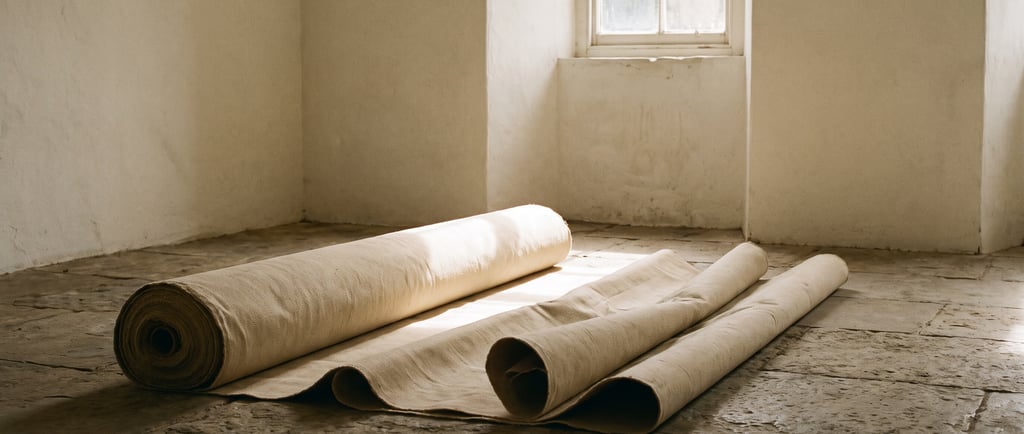
Between 2009 and 2012 I painted in a countryside studio in Morocco. I had a fifty-metre roll of canvas and not much else, and I did not show the work to anyone for three years.
I want to describe what that actually does, because the romantic version of the isolated artist is mostly nonsense and the real version is more interesting.
The first thing that happens is that you get worse. Not immediately, but within a few months. Without anyone looking, the internal editor that normally tells you when something is not working goes quiet, and you produce a run of paintings that are self-indulgent in ways you cannot see. I made a lot of bad work in year one. Some of it I destroyed. Some of it I still have, and I keep it because it marks the low point clearly.
The second thing is that the editor comes back, but it comes back different. When you have not shown anything for a year, you stop asking whether a painting will be liked and start asking whether it is finished. Those are not the same question and most artists never fully separate them. Isolation separates them for you, whether you want it or not.
The third thing, and this is the one I did not expect, is that scale changes.
A fifty-metre roll of canvas is not a practical purchase. It is a commitment. You cannot buy that much canvas and then make small paintings, because the roll sits there reminding you what it is for. So I started working large, and once you start working at that scale you cannot go back easily. A hundred and eighty centimetres square is not a bigger version of a forty-centimetre painting. It is a different physical activity. You paint with your arm and your back, not your wrist. You step away every few minutes because you cannot see the whole thing from close up. The painting starts telling you where to stand.
Large format oil painting also removes a certain kind of preciousness. On a small canvas, every square centimetre feels expensive and you protect it. On a canvas you cannot reach across, there is too much surface to be precious about. You have to move. That movement is visible in the finished work and I do not think I could have manufactured it deliberately.
Working on unstretched canvas straight off the roll had its own effect. The painting had no edges while I was making it. I cut them afterward. That meant composition was a decision made at the end rather than a constraint imposed at the beginning, which sounds like a technical detail and is actually the biggest change in how I work. Several paintings from that period are cropped in ways I would never have planned. The composition was found, not designed.
Practically, that period was difficult in unglamorous ways. Drying times in a hot dry climate are unpredictable. Large canvases take up more room than a countryside studio has. Materials are hard to source, so you learn to work with what you have and you stop being fussy about brands.
But the isolation was the substantive thing, and I have complicated feelings about it. It produced the paintings that anchor everything I have made since. It also cost three years of a career at an age when most artists are building relationships and showing work, and I did not have a plan for what would happen when I came out of it.
When those paintings were finally shown, the response was not what I expected. People kept using the word quiet. I had spent three years alone and I had assumed the work would come out loud.
I think what they were responding to is the absence of an audience in the paintings themselves. Work made to be seen has a certain performance in it, a slight turning-toward the viewer. Work made in an empty room does not. It faces forward because there is nothing else for it to face.
I would not recommend three years to anyone. I would recommend three months, maybe once a decade, with nothing to show at the end of it.
The fifty-metre roll ran out eventually. I bought another one.