From Henna to Oil Painting
Blog post descWhat a disappearing medium taught me about permanence, line, and committing to a mark that cannot be undone.ription.
7/24/20263 min read
People ask why I paint in oil, and they usually expect an answer about colour, or about the way it holds light. The real answer is that I spent years working in a medium that disappeared, and oil was the opposite of that.
Before Toronto, before the canvas, I worked in a henna atelier in Los Angeles. I trained artists there. We drew on skin with paste, and every drawing we made had a fixed lifespan. Two weeks at the outside. Then the stain faded and the work was gone. I helped develop some of the tools used for that kind of drawing at scale, which meant I spent a lot of time thinking about what a line is and how it should behave.
Here is what nobody tells you about drawing in a paste that dries as you work: you cannot correct anything. There is no erasing. There is no lifting the line and putting it somewhere better. You commit or you do not. If your hand hesitates, the hesitation is in the drawing permanently, or at least for the two weeks that permanently means.
That taught me something I could not have learned any other way. Confidence in a line is not a style. It is a physical habit built by thousands of marks you were not allowed to take back.
When I moved to oil, everyone assumed I would find it liberating. Oil forgives. You can scrape it back, paint over it, let it dry and try again in a week. All of that is true and I almost never use it.
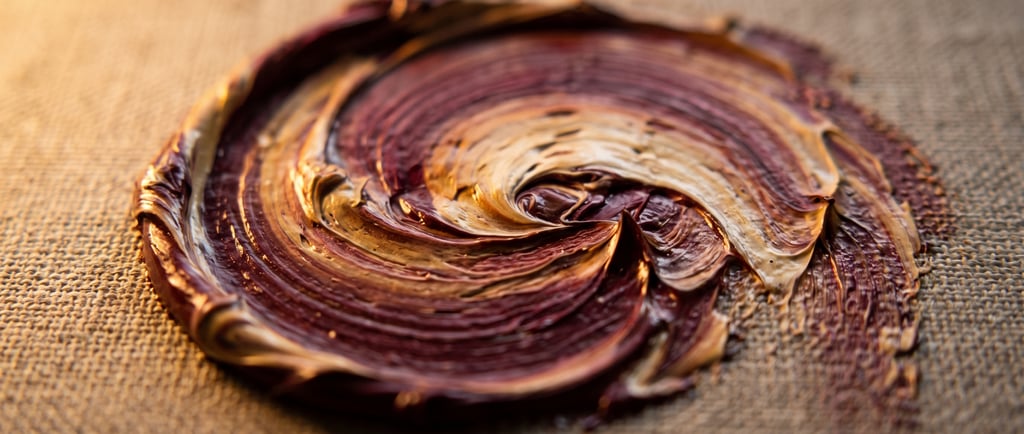
I still work the way I worked with paste. I begin with the line, I commit to it, and I build outward from there. I do not sketch the composition first. I do not plan the colour before I start. The drawing arrives and then I follow it, and if it arrives wrong I would rather live with a wrong line that has conviction in it than a right one that was arrived at by committee.
The other thing henna gave me was radial symmetry. Paste drawing is built on it. You work outward from a centre, repeating motifs around an axis, and the whole tradition of the ornament depends on that structure holding. When people look at my flower paintings and say they look like mandalas or rose windows, they are seeing a habit I formed years before I ever stretched a canvas. La Fleur is not a series about flowers. It is a series about what happens when you take a decorative logic learned on skin and blow it up to a metre and a half of canvas.
There is a question underneath all of this that I have never fully resolved. Why did I need permanence?
The honest answer is that ephemeral work made me anxious in a way I did not notice at the time. You make something good, you photograph it, and then it goes. The photograph is not the work. The work was the thing on the person, in that light, that afternoon, and it does not exist anymore. After enough years of that, I wanted to make something that would still be in the room next year.
Oil on canvas is about as permanent as a human being can practically achieve. Properly made and properly cared for, these paintings will outlast me by centuries. That is not a small thing to think about while you are working. It changes what you are willing to put down.
But permanence has its own trap, which is that it invites you to be careful. If a painting is going to exist for four hundred years, the temptation is to make it safe enough to survive that long. I try to resist this. The paintings I like best in my own body of work are the ones where I can see the decision that could have gone wrong.
There is a bridge between the two mediums that I did not see until much later. Both are about the mark that cannot be argued with. In henna, it is because the material will not let you argue. In oil, it is because you have decided not to.
I would not have arrived at the second without years of the first.
When people ask about my process now, this is really what they are asking about, even if they do not know it. Not the brand of paint. Not the canvas preparation. They want to know how a painting gets decided. The answer is that it gets decided the way a henna line gets decided, quickly, and then the rest of the work is having the nerve to leave it alone.